
A fighting chance:
How Signature of Hope is helping protect South Africa’s rhinos
South Africa is home to the largest population of rhinos in the world, yet every day these magnificent animals face an existential threat. Poaching syndicates, driven by demand for rhino horn in illegal wildlife markets, have pushed both the white and black rhino to the edge. Orphaned calves left behind after their mothers are killed. Adult rhinos maimed and left to die. It’s a crisis that plays out across our reserves, largely out of sight, and often without enough hands to respond.
Signature of Hope Trust believes that when hope turns into action, real change is possible. That is why we proudly support Care for Wild Rhino Sanctuary, the largest rhino orphanage in the world, based in Barberton, Mpumalanga. Through our Planet pillar, we have channelled resources directly into one of the most urgent conservation efforts on the continent.
From the poaching frontline to the ICU
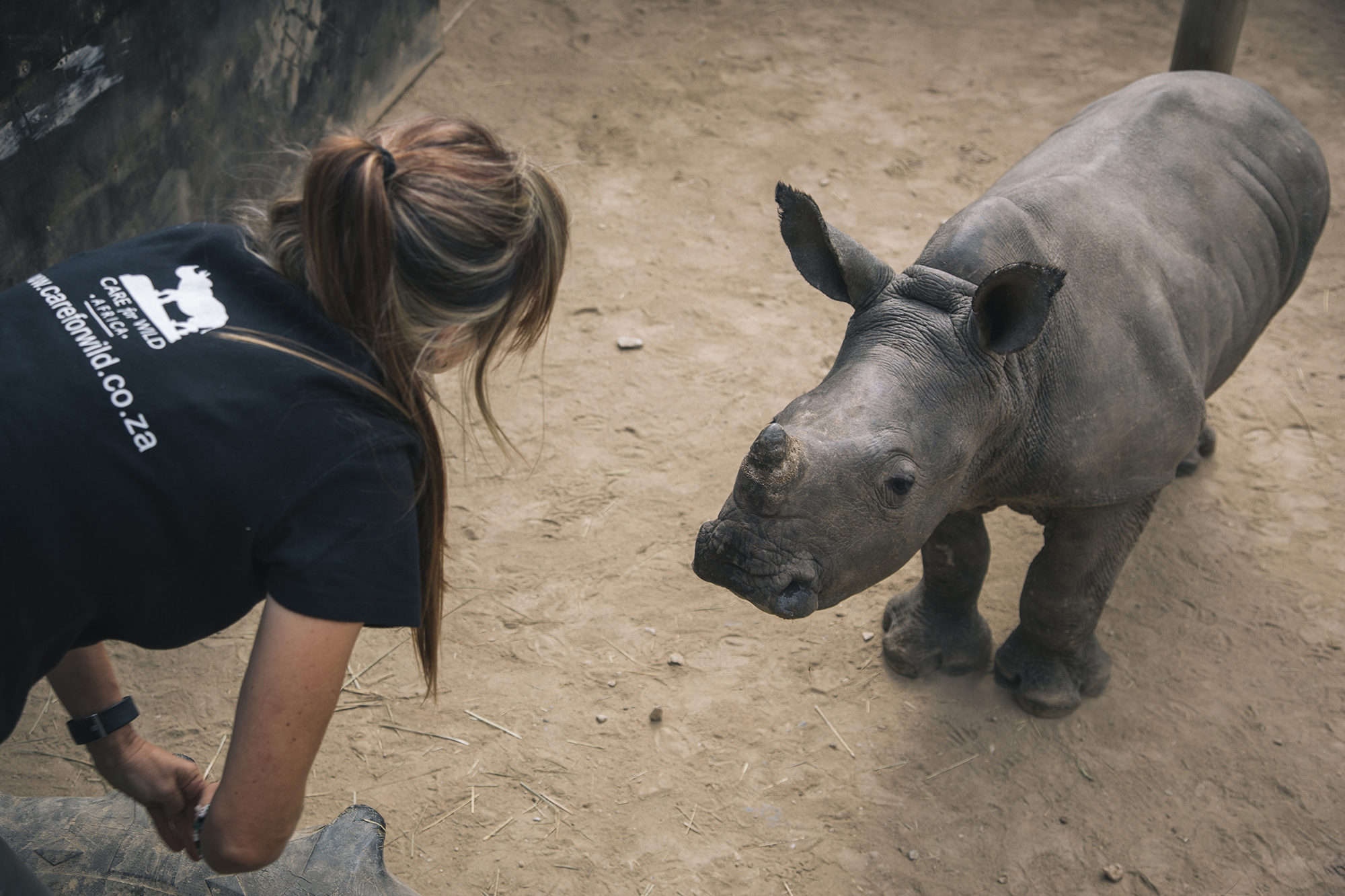
When a rhino calf loses its mother to a poacher’s bullet, the clock starts ticking immediately. Without the protection and milk of its mother, a calf is defenceless against predators and will succumb to starvation within days. Care for Wild works in close partnership with SANParks and the Mpumalanga Tourism and Parks Authority to locate and rescue these orphans as quickly as possible.
The process is delicate and demands expertise. Each calf must be darted and immobilised, fitted with blindfolds and earplugs to reduce trauma, and transported to the sanctuary, sometimes by helicopter. On arrival, the Care for Wild team begins around-the-clock care in a purpose-built Intensive Care Unit. Carers bottle-feed very young calves every two hours, day and night, with each calf receiving up to 16 litres of milk daily in the early stages. Every animal, every wound, every behaviour is recorded in a comprehensive digital system so that the best possible decisions can be made for each individual rhino.
To date, Care for Wild has rescued 109 rhinos, 22 of them admitted with serious injuries. Fourteen calves have been born at the sanctuary itself. It is conservation that is tangible, measurable, and deeply personal.
One of the most controversial and yet crucial tools in the fight against poaching is rhino dehorning. Because rhino horn commands extraordinary prices on the black market, poachers target any animal carrying a horn. By surgically removing the horn under veterinary anaesthesia, conservation teams eliminate the very thing that makes an individual rhino a target.
At Care for Wild, dehorning is carried out as part of a broader protection strategy by a specialised veterinary team. The procedure is safe for the animal, as rhino horn is composed of keratin and grows back over time. Dehorned rhinos experience no lasting harm and, crucially, a dramatically reduced risk of attracting a poacher. It is an uncomfortable reality of modern conservation: sometimes protection means removing what poachers want most.
Care for Wild does not rely on veterinary care alone. The sanctuary operates a sophisticated anti-poaching unit comprising 57 members, including a mounted unit of 18 horses and a K9 unit of 7 trained canines. AI-enabled tracking collars, developed in partnership with Rouxcel Technology, monitor rhino behaviour in real time and trigger alerts when irregular activity is detected. The EarthRanger software platform integrates GPS tracking, remote sensing, and data analytics so that rangers always have the clearest possible picture of what is happening across the sanctuary’s 28,000-hectare range.
Conservation cannot succeed without community. Care for Wild has created 600 jobs in the surrounding area and runs active programmes including a Junior Ranger initiative for local youth and 16 community sports teams. By giving communities a direct stake in the sanctuary’s success, Care for Wild is building an ecosystem of protection that extends far beyond the fence line.
The results speak for themselves. Over 3,500 consecutive days without a poaching incursion at the main sanctuary. Thirty-five rhinos successfully re-wilded into the Barberton Nature Reserve. A clear pathway towards self-sustaining breeding populations of both white and black rhinos.
Where hope turns into action
At Signature of Hope, we are proud to have played a part in this extraordinary work. Our support for Care for Wild reflects our belief that protecting our planet’s wildlife is inseparable from the wellbeing of the communities and ecosystems surrounding it. South Africa’s rhinos deserve a future. With the right partnerships, the right technology, and the right level of commitment, that future is within reach.
Contact us
Suite 1002, The Colosseum, Foyer 3, Mezzanine level, 26 Century Boulevard, Century City, Cape Town, 7441
+27 21 201 1000
info@signatureofhope.org
Subscribe to our newsletter
NPO Registration number: 196-195NPO | Public Benefit Organisation Registration number: 930044595 | Trust registration number: IT 1351/ 2013
Copyright © 2016 SIGNATURE OF HOPE. All Rights Reserved. Signature of Hope is proudly supported by Carrick.
https://shorturl.fm/poSuD
https://shorturl.fm/puv95
https://shorturl.fm/O8S5t
https://shorturl.fm/uqZ0D
https://shorturl.fm/iIB4c
https://shorturl.fm/AfXdv
https://shorturl.fm/Jm4Bl
https://shorturl.fm/Bkf6q
https://shorturl.fm/fVc5L
https://shorturl.fm/LvAUK
https://shorturl.fm/VJj2Q
https://shorturl.fm/mlyLD
https://shorturl.fm/9a2nz
https://shorturl.fm/15zfD
https://shorturl.fm/3XK7T
https://shorturl.fm/Noepo
https://shorturl.fm/KfV4Z
https://shorturl.fm/o9DjA
https://shorturl.fm/WeRvb
https://is.gd/1n94DI
https://is.gd/ee7ro6
https://shorturl.fm/v0279
https://shorturl.fm/BN4uO
https://shorturl.fm/sFPO1
https://shorturl.fm/rPy94
https://shorturl.fm/rlKZM
https://shorturl.fm/GuGdM
https://shorturl.fm/1fZ8I
https://shorturl.fm/8bECQ
https://shorturl.fm/ykFsU
https://shorturl.fm/FoivA
https://shorturl.fm/edQel
https://shorturl.fm/il476
https://shorturl.fm/qpdSr
https://shorturl.fm/QB0i9
https://shorturl.fm/abonA
https://shorturl.fm/QYiui
https://shorturl.fm/aoL74
https://shorturl.fm/VS7L4
https://shorturl.fm/5QDtd
https://shorturl.fm/faOz8
https://shorturl.fm/SGNk2
https://shorturl.fm/ZgcOx
https://shorturl.fm/9wDQ2
https://shorturl.fm/r8hPh
https://shorturl.fm/YlEql
https://shorturl.fm/WhbVW
https://shorturl.fm/dQJLA
https://shorturl.fm/H250L
https://shorturl.fm/RfAA2
https://shorturl.fm/e48A4
https://shorturl.fm/ICO3d
https://shorturl.fm/Ibv5E
https://shorturl.fm/IyhT3
https://shorturl.fm/Lmz8h
https://shorturl.fm/b7xuC
https://shorturl.fm/yZuqL
https://shorturl.fm/hF1VK
https://shorturl.fm/KIpgx
https://shorturl.fm/C4dkJ
https://shorturl.fm/UwxKW
https://shorturl.fm/HJJXC
https://shorturl.fm/QzE58
https://shorturl.fm/wtGh6
https://shorturl.fm/PaVJ2
https://shorturl.fm/fBypL
https://shorturl.fm/fWTgz
https://shorturl.fm/29vPG
https://shorturl.fm/AHhJk
https://shorturl.fm/Xtcow
https://shorturl.fm/fp9SI
https://shorturl.fm/lM9RS
https://shorturl.fm/adQ23
https://shorturl.fm/ilBJs
https://shorturl.fm/3L4wB
https://shorturl.fm/1stc6
https://shorturl.fm/hyvKE
https://shorturl.fm/nQCdJ
https://shorturl.fm/5OJlr
https://shorturl.fm/QDgz3
https://shorturl.fm/WgTHV
https://shorturl.fm/EHKeW
https://shorturl.fm/wROA1
https://shorturl.fm/if5wM
https://shorturl.fm/6LvbC
https://shorturl.fm/rCKI8
https://shorturl.fm/4Sp9U
https://shorturl.fm/UobiV
https://shorturl.fm/OhAJf
https://shorturl.fm/2eHBF
https://shorturl.fm/ZTkxg
https://shorturl.fm/9O5fW
https://shorturl.fm/IxbJR
https://shorturl.fm/1d9nG
https://shorturl.fm/tDvsO
https://shorturl.fm/hcdIV
https://shorturl.fm/ioCLp
https://shorturl.fm/EUlWu
https://shorturl.fm/dOXQD
https://shorturl.fm/tVwrt
https://shorturl.fm/mQDHi
https://shorturl.fm/daIpV
https://shorturl.fm/o8I7H
https://shorturl.fm/LSVYW
https://shorturl.fm/t2w6s
https://shorturl.fm/z22a7
https://shorturl.fm/PNxu7
https://shorturl.fm/u6Udj
https://shorturl.fm/mHRYR
https://shorturl.fm/RjIrC
https://shorturl.fm/D9K2C
https://shorturl.fm/lQ1Ew
https://shorturl.fm/uQf0a
https://shorturl.fm/1Tvhr
https://shorturl.fm/6n0tM
https://shorturl.fm/KNSom
https://shorturl.fm/KnTkO
https://shorturl.fm/5vINd
https://shorturl.fm/OROOA
https://shorturl.fm/OROOA
https://shorturl.fm/bHmnv
https://shorturl.fm/TdKh7
https://shorturl.fm/D5l4k
https://shorturl.fm/3SLGt
https://shorturl.fm/ksPHx
https://shorturl.fm/EN33V
https://shorturl.fm/Rjj84
https://shorturl.fm/k4Yg4
https://shorturl.fm/Lv7ec
https://shorturl.fm/tN9Rx
https://shorturl.fm/TaUfO
https://shorturl.fm/azk1b
https://shorturl.fm/iMh0S
https://shorturl.fm/1szJj
https://shorturl.fm/7RIMS
https://shorturl.fm/DhwJz
https://shorturl.fm/97m0B
https://shorturl.fm/hWF0B
https://shorturl.fm/EVt2K
https://shorturl.fm/OIz95
https://shorturl.fm/LqPiR
https://shorturl.fm/vetUR
https://shorturl.fm/n2l64
https://shorturl.fm/QNo0q
https://shorturl.fm/bRBwD
https://shorturl.fm/uSVX5
https://shorturl.fm/ovVjr
https://shorturl.fm/qRVwM
https://shorturl.fm/V84Xq
https://shorturl.fm/KFO4x
https://shorturl.fm/nHFM9
https://shorturl.fm/LTIcK
https://shorturl.fm/cT6DZ
https://shorturl.fm/fqu0x
https://shorturl.fm/h7B8w
https://shorturl.fm/hISc4
https://shorturl.fm/1IPvB
https://shorturl.fm/1FD6k
https://shorturl.fm/jfp89
https://shorturl.fm/4uzmo
https://shorturl.fm/5Mo9v
https://shorturl.fm/a7737
https://shorturl.fm/Oznjj
https://shorturl.fm/vUOAe
https://shorturl.fm/K1viq
https://shorturl.fm/5SQMU
https://shorturl.fm/jifaF
https://shorturl.fm/oFfg5
https://shorturl.fm/WVUvF
https://shorturl.fm/3knUS
https://shorturl.fm/4InO6
https://shorturl.fm/nNJQS
https://shorturl.fm/RxEwj
https://shorturl.fm/1g5zE
https://shorturl.fm/ZHI0J
https://shorturl.fm/5OBGr
https://shorturl.fm/IWAIH
https://shorturl.fm/It0xc
https://shorturl.fm/a2y6N
https://addlinks.pro/mxmLI